
While there are no specific criteria for “best,” history shows that McKinsey judges favor articles that offer both original theoretical insights and direction for their practical application. These articles simultaneously expand the thinking on a topic and inspire action.
The winners of this year’s first- and second-place McKinsey Awards are no exception. And the authors themselves are no strangers to the awards. The three of them have now been honored 11 times for articles that have launched some of the most famous and influential ideas in business.
Harvard Business Review is pleased to announce that Michael E. Porter and Mark R. Kramer, the coauthors of “Strategy and Society: The Link Between Competitive Advantage and Corporate Social Responsibility,” have won the first-place 2006 McKinsey Award. Gary Hamel, the author of “The Why, What, and How of Management Innovation,” is the second-place winner.
Since 1959, the McKinsey Foundation for Management Research has presented awards recognizing the two best articles published each year in Harvard Business Review. The awards, judged by an independent panel of business leaders and scholars, commend outstanding works that are likely to have a major influence on executives worldwide.
HBR wishes to thank this year’s panel of judges for their hard work on behalf of the 2006 awards:
Kim B. Clark
President
Brigham Young University – Idaho
Rexburg, Idaho
Michael J. Critelli
Chairman and Chief Executive Officer
Pitney Bowes
Stamford, Connecticut
Lee C. Daley
Chairman and Chief Executive Officer
Saatchi & Saatchi UK Group
London
Anand G. Mahindra
Vice Chairman and Managing Director
Mahindra & Mahindra
Mumbai, India
Dermot Mannion
Chief Executive
Aer Lingus
Dublin, Ireland
Michael E. Marks
Senior Advisor
Kohlberg Kravis Roberts & Co.
Menlo Park, California
Anne M. Mulcahy
Chairman and Chief Executive
Xerox
Stamford, Connecticut
Walter J. Salmon
Stanley Roth, Sr., Professor of Retailing, Emeritus
Harvard Business School
Boston
Linda G. Sprague
Professor of Manufacturing and Operations Management
China Europe International Business School (CEIBS)
Shanghai, China
Dorothy A. Terrell
President and Chief Executive Officer
Initiative for a Competitive Inner City
Boston
“Strategy and Society: The Link Between Competitive Advantage and Corporate Social Responsibility”
December 2006
First-Place Winner
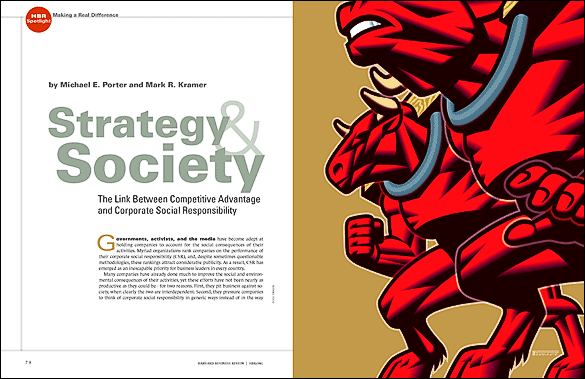
Corporate social responsibility has become an inescapable priority for business leaders across the globe. Governments, activists, and the media now hold companies accountable for the social consequences of their actions, and favorable publicity is often bestowed on companies with prominent CSR programs. Yet for all the hype surrounding CSR efforts, they are frequently counterproductive.
Michael Porter and Mark Kramer propose a new way to view the relationship between business and society that allows companies to make valuable contributions to social welfare without sacrificing corporate success. They introduce a framework that companies can use to identify the social consequences of their actions, determine which problems to address, and find the most effective ways to do so while simultaneously strengthening the competitive context in which they operate. By analyzing their opportunities for CSR using the same guidelines that direct their core business decisions, companies will discover that CSR can be much more than a cost or constraint—it can be a potent source of innovation and competitive advantage.
Reprint R0612D
Michael E. Porter is the Bishop William Lawrence University Professor at Harvard University; he is based at Harvard Business School in Boston.Mark R. Kramer (mark.kramer@fsg-impact.org) is the managing director of FSG Social Impact Advisors, an international nonprofit consulting firm, and a senior fellow in the CSR Initiative at Harvard’s John F. Kennedy School of Government in Cambridge, Massachusetts. Porter and Kramer are the cofounders of both FSG Social Impact Advisors and the Center for Effective Philanthropy, a nonprofit research organization.
“The Why, What, and How of Management Innovation”
February 2006
Second-Place Winner
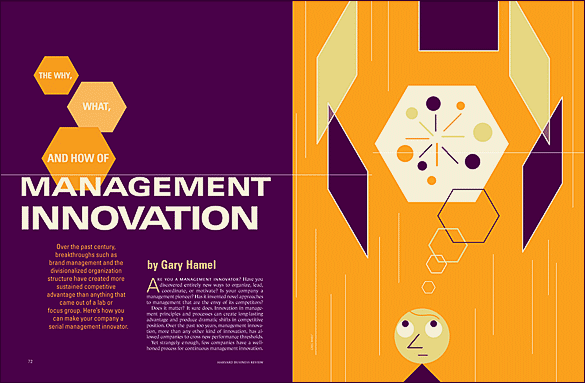
To most people, innovation means new products, new ways of marketing, and new technologies. But management itself, writes Gary Hamel, is a fertile ground for innovation. In fact, Hamel argues, managerial innovations like brand management or the divisionalized corporation have created greater value and longer-lived competitive advantage than anything that came from a focus group or a laboratory.
The key to managerial innovation is looking for powerful ideas in unusual places and challenging management orthodoxies. Drawing on rich examples from companies such as General Electric, Visa, and Google, Hamel shows how “serial innovators” gain advantage over rivals. He also offers a methodology that executives can use to identify their own opportunities to reinvent management processes. “So far,” Hamel writes, “management in the twenty-first century isn’t much different from management in the twentieth century. Therein lies the opportunity.”
Reprint R0602C
Gary Hamel (ghamel@woodsideinstitute.org) is a visiting professor at London Business School and a founder of Strategos, an international consulting company based in Chicago. He is also the director of the Woodside Institute, a nonprofit research foundation based in Woodside, California.